- Role
- Growth & Performance Marketing Strategist
- What's inside
- Full-funnel strategy, campaign art direction, ad and email copy, a working automation, and a 30-day model with two scenarios.
- Tools
- Meta Ads, Klaviyo, Make.com, Google Sheets, Gmail
- When
- July – August 2026
- Type
- Concept project — no client, no real sales.
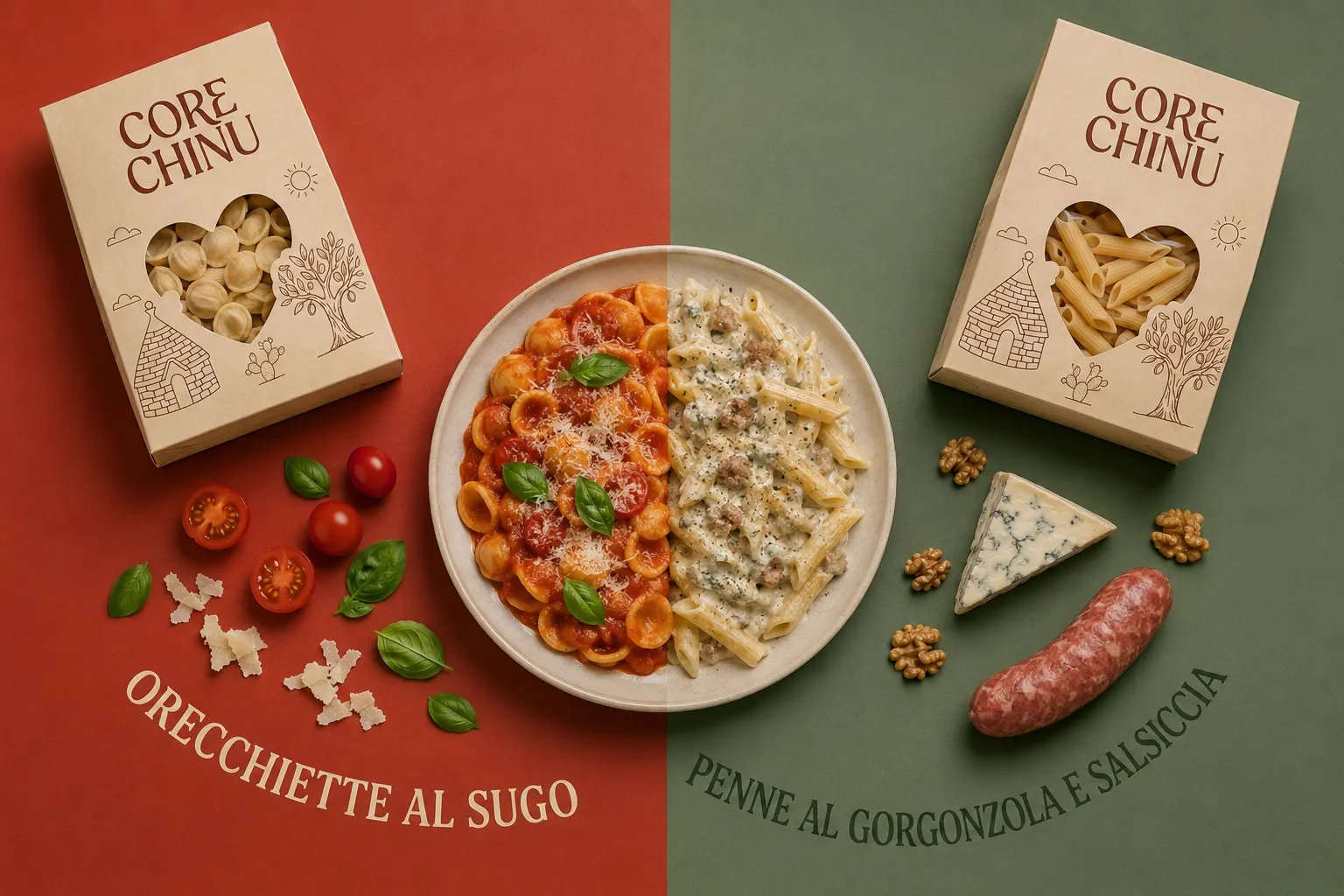
The challenge here wasn’t just selling fresh pasta. It was convincing someone that it was worth buying.
Because the first question would be: but will it actually arrive in good condition? And right after that, there would be another one: why should I pay that much for it when I can already find Apulian products in Milan?
The whole project starts with these two questions. From the campaign to the landing page, from the discount to the emails, I tried to build a journey that addressed the delivery concern first, and then made the case for the value of the product.
Core Chinu doesn’t actually exist, and there’s no client behind this project. I built everything as if it were really going to launch — with a product, an audience, a budget, and even orders that never came. I needed to build it that way to see how far the idea could actually hold up.
The brief
The idea was a small artisanal workshop making traditional Apulian fresh pasta, sold online and delivered within 24 hours through a certified cold chain.
The audience? People who grew up in Southern Italy and moved to Milan or elsewhere in Northern Italy — people who miss those flavours but don’t always have the time to cook.
But nostalgia alone isn’t enough. Especially in a market where Apulian products are already available far beyond Puglia.
So Core Chinu needed to give people a reason to choose that particular box and pay its price. It couldn’t simply say “I’ll bring a piece of Puglia to your door”, because some version of that piece of Puglia was already available.
Then there was the more practical problem: the pasta is fresh and refrigerated. Before even thinking about the taste, customers need to know it can make it through a 24-hour journey to their doorstep without spoiling.
The brief took the operational side as a given: the pasta would be shipped refrigerated and delivered within 24 hours. My job was to figure out how to make both claims believable: that the pasta would arrive in good condition, and that it would be worth the price.
Before the campaign, the box has to do some convincing
So I decided to start there.
An insulated bag, ice packs, and a sticker inside the lid reading 4°C · 24 HOURS.
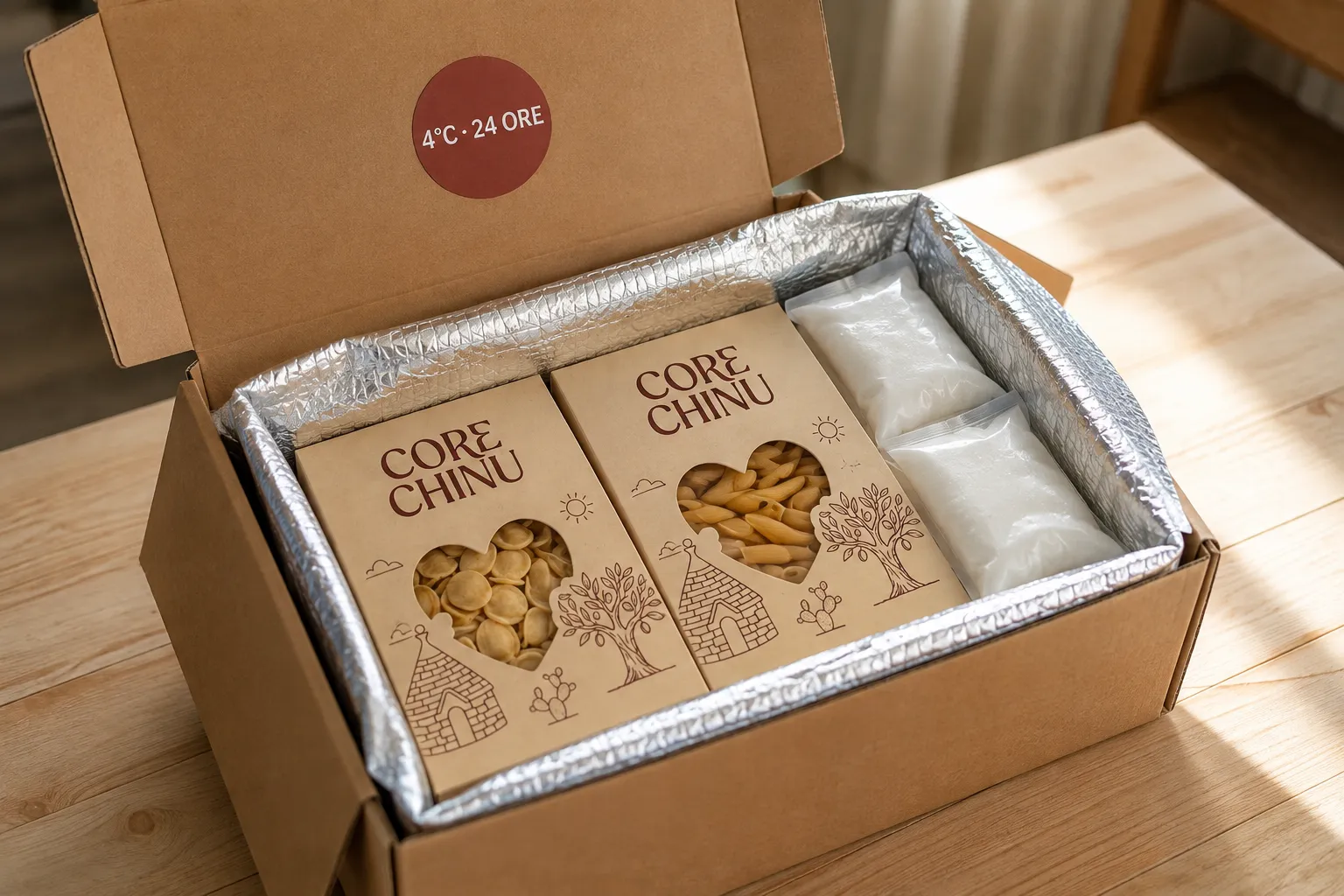
I didn’t want the cold chain to be something I only talked about on the landing page. It had to be visible when the product actually arrived at someone’s door.
In other words, the packaging itself had to answer the first of the two questions: did it arrive in good condition?
The strategy: taking Marco all the way to the second order
To put a face to the audience, I imagined Marco: 32, an account manager in the tech industry in Milan, originally from Southern Italy. He likes good food, but doesn’t have much time to cook during the week and is tired of supermarket pasta.
His problem, though, isn’t simply finding something that reminds him of home. First, he needs to trust that the pasta can make it to Milan still fresh and then understand why he should choose Core Chinu over the many Apulian products he can already find here.
So I built the funnel around answering his questions one at a time.
1. Create the craving
It starts on Meta with short videos designed to feel like small pieces of UGC, tapping into nostalgia without stopping at the usual “you miss home” message.
The idea is to grab Marco’s attention with something he can recognise: a flavour, a memory, a familiar situation. But even here, the campaign needs to leave room for the next question: okay, but how does it make it all the way to Milan?
2. Remove the doubt
From there, he lands on the landing page.
I worked on two versions, built with the same content and the same offer, but arranged in a different order.
Variant A starts with proof: the cold chain, delivery within 24 hours, the guarantee, and everything else needed to make the promise credible.
Variant B starts with nostalgia instead: desire first, then the information needed to reassure someone who’s considering buying.
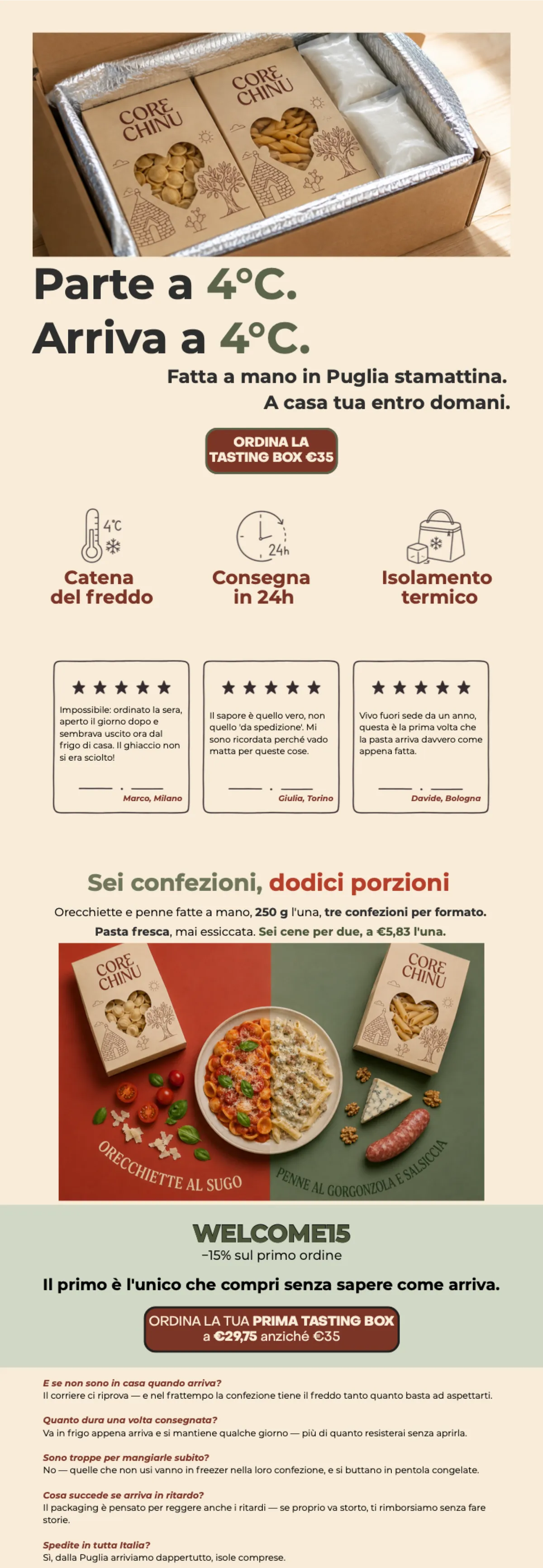
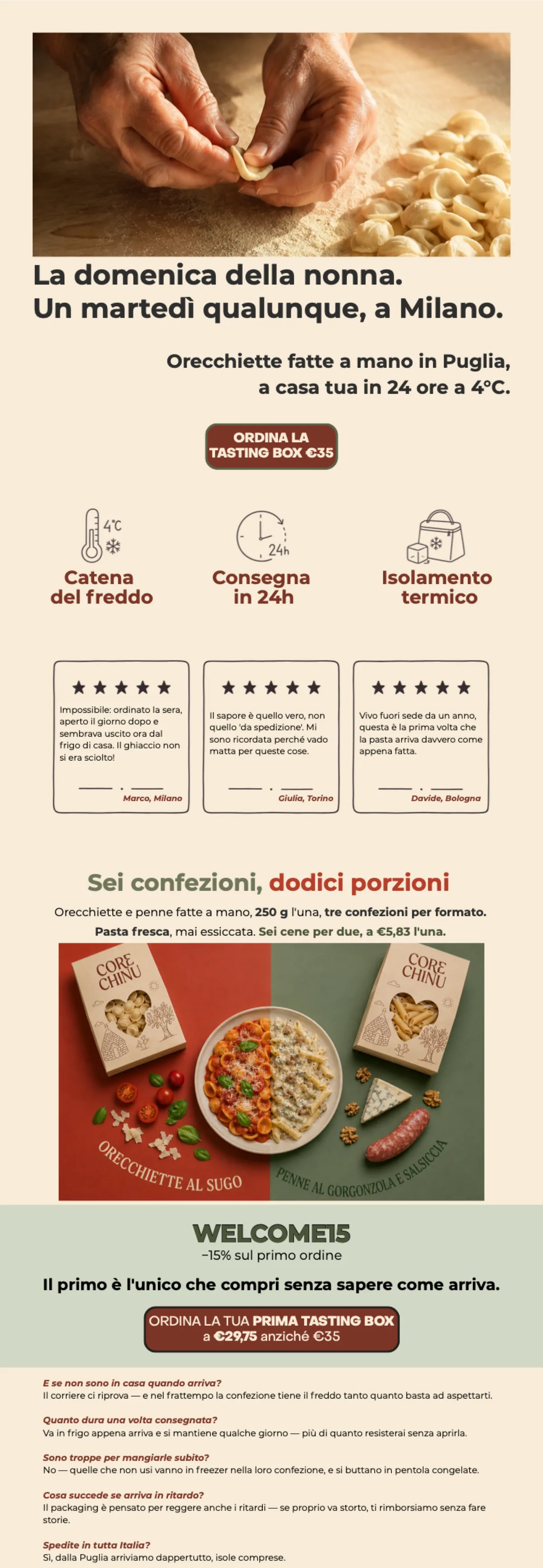
In both versions, the rest of the page stays exactly the same. Only what comes first changes.
The question is simple: what works better — reassurance or desire?
3. Drive the first order
At this point, the 15% first-order discount and the cold-chain guarantee come into play.
The 15% is there for one reason: to make it a little easier to try a product the customer has never bought before and doesn’t fully trust yet.
To increase the value of the first purchase, I also introduced a Tasting Box, with a target AOV of €35.
The goal isn’t to compete on price with the Apulian products Marco can already find in Milan, but to make the first order valuable enough to make buying Core Chinu online feel worth it.
4. Bring him back
The fourth step comes after delivery, with Make.com.
At this point, Marco has already received his first box, so delivery is no longer a promise: he’s just experienced it for himself.
I built an automation that checks what happened with the delivery: if the pasta arrives within 24 hours, Make sends the customer an email; if it arrives late, it logs the delay and sends an alert to customer care. A third path handles cases where the delivery time is missing or can’t be read.
On day 20, Klaviyo comes in with the Quick 1-Click Refill, which I designed as a mockup but did not actually automate.
The 15% discount belongs to the first order: it makes it easier to try Core Chinu. On day 20, if the first box arrived in good condition, the email suggests a second order without another discount.
At that point, I don’t need to convince him the pasta will arrive safely anymore: he already knows it will.
The automation
At this point, there was a very practical question: what happens after the customer places an order?
I built a working automation in Make.com that starts from the delivery event and checks whether the pasta arrived within the expected 24-hour window.
This isn’t just a diagram: I built the prototype end to end, with a webhook receiving the delivery event, a router checking the 24-hour window, and three different paths.
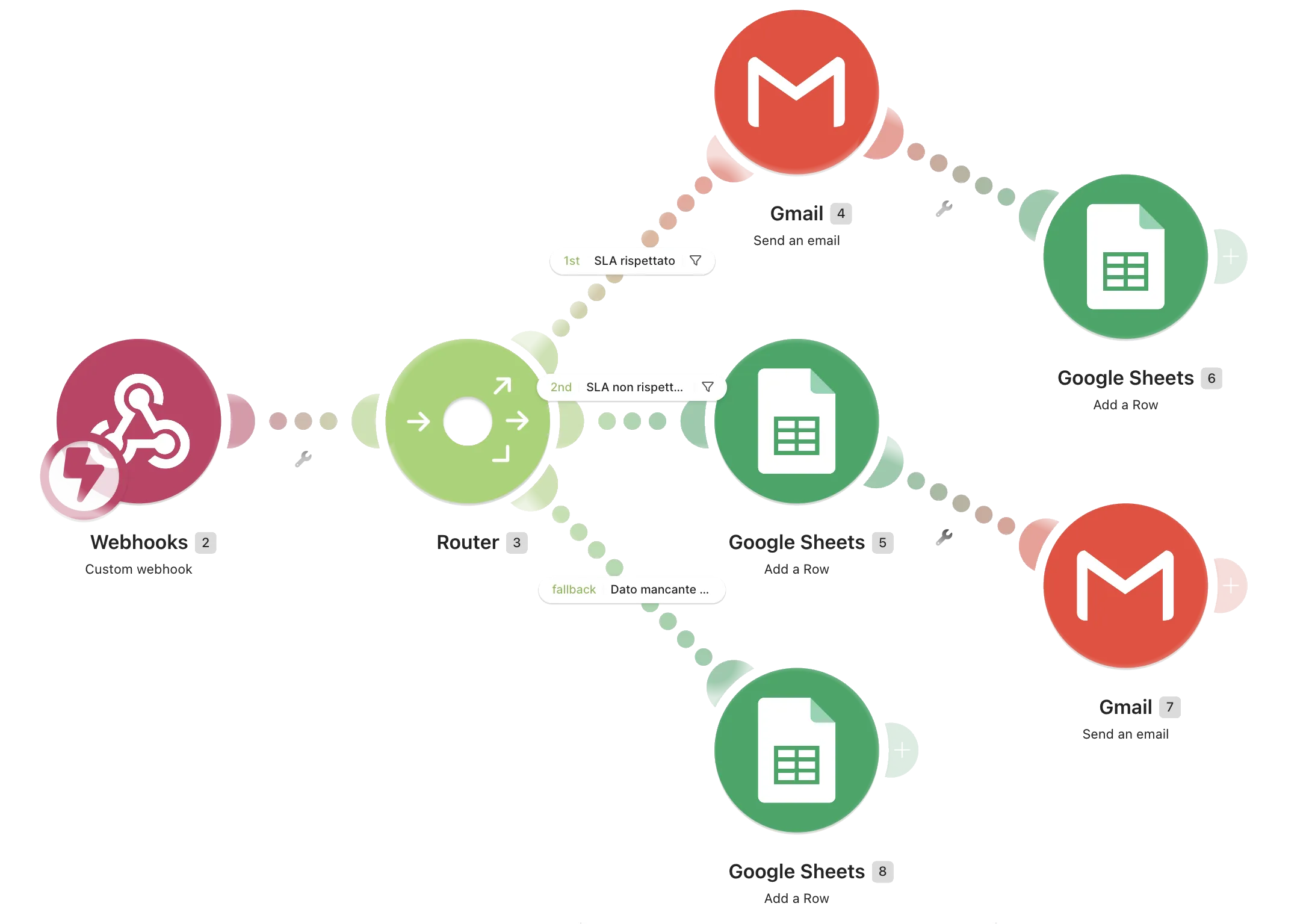
If the delivery arrives within 24 hours, a short email is sent, playfully turning the customer’s pre-purchase concern back on itself: the pasta made it. Their doubts, not so much. There’s no need to talk about nostalgia anymore — it’s already done its job. Now I can play with the trust the customer has just gained.
If the delivery takes longer than 24 hours, the system logs the delay and alerts customer care. In this case, there’s no congratulatory email: the problem needs to be dealt with first.
There’s also a third path for cases where the delivery time is missing or can’t be read. Here too, the system doesn’t assume everything went well: it logs the case separately, because without a delivery time, I can’t know whether the 24-hour promise was met.
All three outcomes are recorded in the same Google Sheet. This lets me keep track not only of how many deliveries arrive on time, but also how many are late and how many have missing data.
I also planned the emails that accompany the customer at different points in the journey. The Welcome email and the Quick 1-Click Refill on day 20 were designed as Klaviyo mockups. The email following an on-time delivery, on the other hand, is directly connected to the Make.com automation and was actually tested during the trials.
When a delivery falls outside the SLA, Make.com also sends an email to customer care with the order details and the number of hours overdue.
The copy
The copy follows the different stages of the journey: from the first impression made by the campaign, to the decision to try the product, through to delivery and the attempt to bring the customer back for a second order.
Before the purchase
For the campaign, I chose a warm, nostalgic and slightly ironic tone. I wanted to start from memories and familiar habits for people who grew up in Southern Italy and now live far from home, without stopping at nostalgia alone.
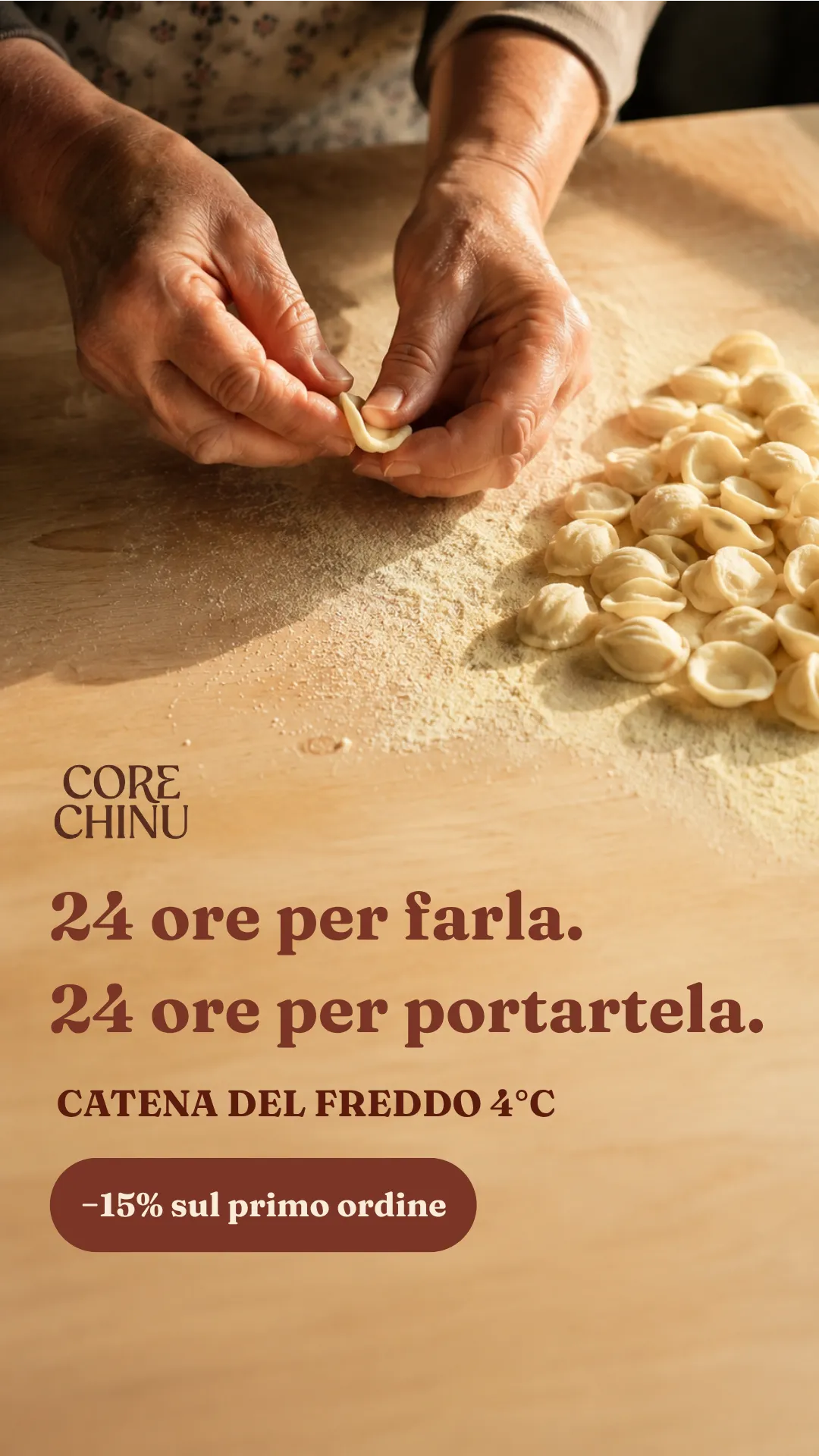
One of the ads plays with the relationship between time and pasta:
“Your grandpa always said that rushing ruins good things. That’s why our fresh pasta takes 24 hours to make. And getting it to your door… takes the same amount of time.”
The 24 hours therefore tell two stories at once: the time needed to make the pasta and the time needed to deliver it. Slowness becomes part of the product rather than something that needs to be justified.
I also planned a short video centred on the hands making the pasta. The idea was to show the product and the work behind it, connecting what is made in the workshop with what the customer will receive at home.
The emails
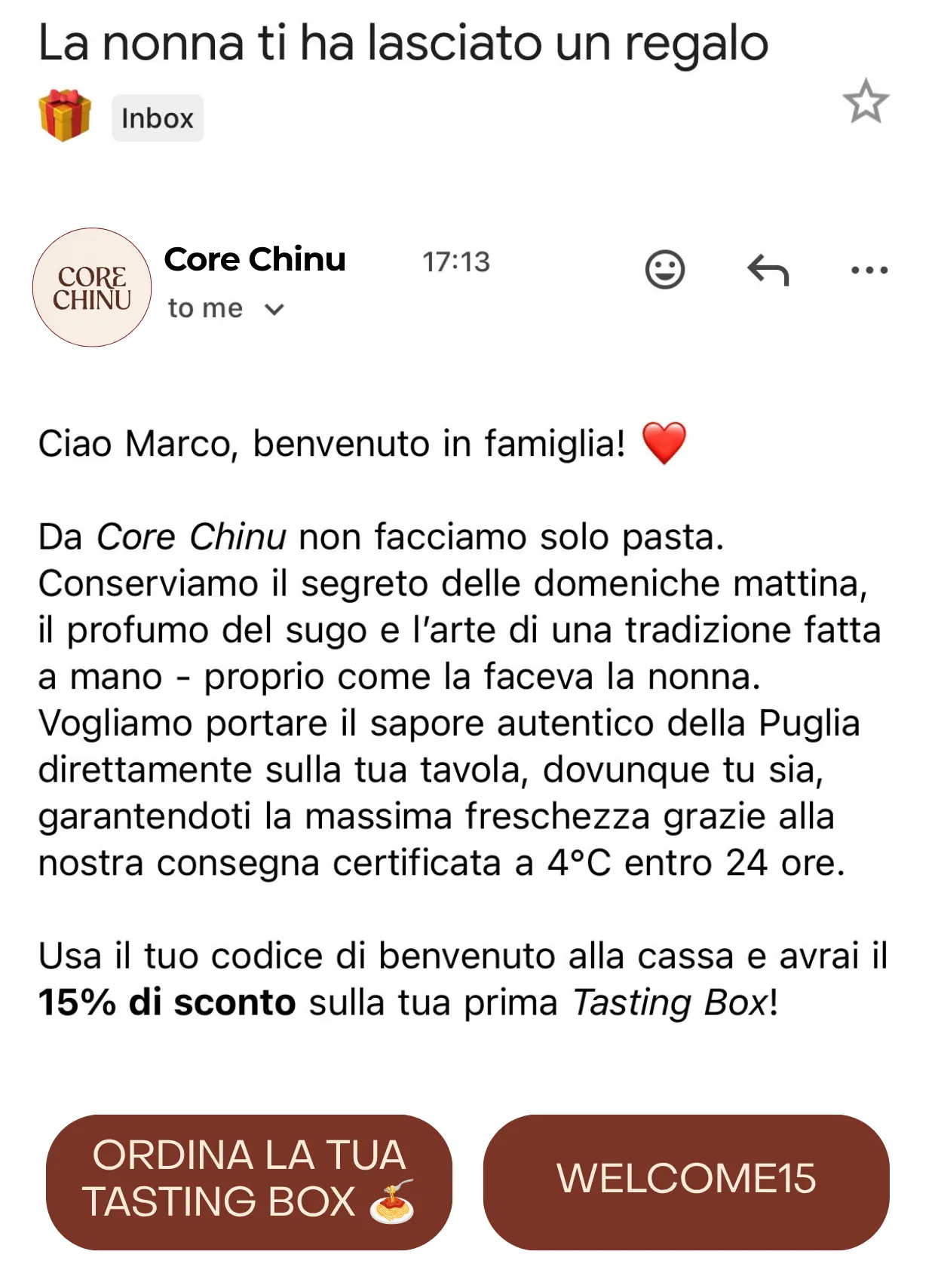
To guide the customer after the first contact, I planned three emails, each with a different purpose.
The first comes after signing up or making an initial contact with the brand and includes a 15% discount on the first purchase. The discount makes it easier to try a product the customer hasn’t bought before and whose promise they still need to verify.
The second comes after delivery. If the pasta arrives within the expected 24 hours, Make.com triggers the path for an on-time delivery, and the email plays directly on the doubt the customer had before ordering.
Subject: The pasta made it. Your doubts, not so much.
Hi Marco,
your pasta made it. Yes, the very one you had your doubts about.
24 hours on the road, zero surprises: maybe next time you’ll trust us a little more.
Enjoy from Nonna!
Here, I can joke about the doubt because this time I have a concrete answer: the pasta arrived within the promised 24 hours.
The third email comes on day 20 and introduces the Quick 1-Click Refill. It doesn’t offer another 15% discount: that belongs to the first order and was there to make trying the product easier. After a successful delivery, the customer has already experienced the product’s main promise for themselves.
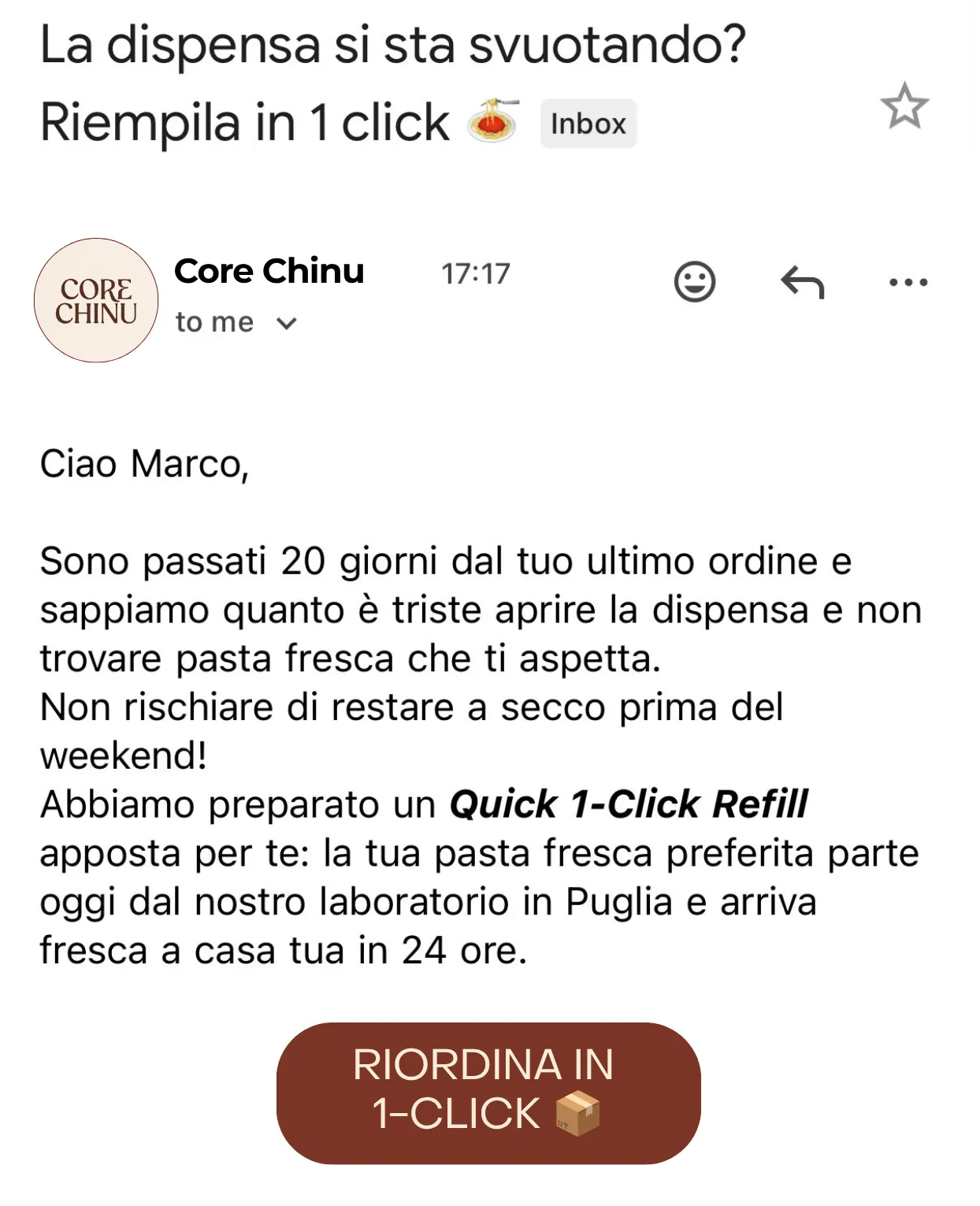
So I designed three emails for three different moments: try, prove, come back. The Welcome and Refill are presented as mockups; the delivery email, on the other hand, is connected to the Make.com automation and was actually tested.
The 30-day model
After building the funnel, I wanted to put some numbers behind it too: if Core Chinu actually launched, what could happen during a first 30-day advertising test?
I didn’t have any real data to work with: the brand doesn’t exist, so there are no campaigns, orders or customers to analyse. I therefore built a model using some published benchmarks for e-commerce1, advertising23 and email marketing45 as reference points, adding my own assumptions wherever I didn’t have a real figure.
The goal wasn’t to predict how much Core Chinu would make, but to understand whether the funnel made economic sense and which numbers I would need to keep an eye on once it launched.
I assumed an advertising budget of €100, a CPM of €8, a CTR of 2.80%, a landing page conversion rate of 2.86%, and an AOV of €35.
With these figures, the model results in roughly 12,500 impressions, 350 clicks and 10 orders.
| 30-day model | |
|---|---|
| Advertising budget | €100 |
| CPM | €8 |
| Impressions | 12,500 |
| CTR | 2.80% |
| Clicks | 350 |
| Landing page conversion rate | 2.86% |
| Orders | 10 |
| AOV | €35 |
| Revenue at full price | €350 |
| Revenue after 15% discount | €297.50 |
| CAC | €10 |
| Return on ad spend | 2.98x |
There’s an important caveat here too: these are not results from a real campaign. They are the mathematical result of the assumptions I used to build the model.
That’s why I compared a more conservative scenario with a more optimistic one, changing the main variables to see how much the final result could shift. I also calculated the break-even point based on the available contribution margin: before spending more on advertising, I want to know how much I can afford to spend to acquire a customer without losing money.
| Conservative — median benchmarks3 | Optimistic — model above | |
|---|---|---|
| Click-through rate | 1.85% | 2.80% |
| Landing page conversion | 2.02% | 2.86% |
| Clicks | 231 | 350 |
| Orders | 4.7 | 10 |
| Revenue at list price | €163 | €350 |
| Revenue collected | €139 | €298 |
| Return on ad spend | 1.39x | 2.98x |
| Customer acquisition cost | €21 | €10 |
Neither scenario tells me whether the business would actually be profitable. A campaign breaks even when the return is equal to one divided by the contribution margin: the optimistic scenario requires a 34% margin, while the conservative one requires 72%. The margin on a €35 box shipped refrigerated isn’t included in the brief and I haven’t estimated it here — it’s the first number I’d ask a client for, because it determines whether either scenario could actually work as a business.
So the model isn’t there to prove that Core Chinu would work. It’s there to understand whether the starting assumptions make sense and what I would change if the real data, once the campaign launched, turned out to be different from what I expected.
What happens after the first order?
Getting the first order isn’t enough. The real goal is to give Marco a reason to come back and buy again.
To understand what might happen after the first purchase, I also made some projections and compared them with email marketing and retention benchmarks: a 48.5% open rate for the Welcome email (the benchmark ranges from 40% to 60%4), a 26% 90-day repurchase rate (one point above the upper end of the 18–25% range1 — my most optimistic assumption), and 22% of revenue generated by email (within the 20–30% range5).
Email open rates are less reliable as a metric today, partly because of Apple Mail Privacy Protection, and benchmarks can vary significantly depending on the industry and type of business.
What I’d look at first
1. How much can I afford to spend to acquire a customer?
Before increasing the advertising budget, I’d start with the contribution margin: how much is actually left after the costs directly tied to selling a box.
From there, I can calculate the maximum sustainable CAC and see whether the acquisition cost assumed in the model is compatible with the product’s margin.
2. What makes Marco buy?
In the model, I assumed Marco could have two different doubts: on one hand, “will the pasta really arrive in good condition after 24 hours?”; on the other, “why should I buy it online when I can already find Apulian products in Milan?”
To find out which message works better, I’d test the two landing pages. The content would stay exactly the same; only the order in which the product is presented would change.
- Variant A: I’d start with the cold chain and 24-hour delivery, addressing the delivery concern straight away.
- Variant B: I’d start with nostalgia and the desire for the product, creating interest first and getting to the delivery information afterwards.
Then I’d compare how many people go on to purchase from each version.
3. What would I do if the ads weren’t bringing enough people to the landing page?
I set an attention threshold for the CTR: 1.85%3.
If the CTR dropped below that threshold, before changing the video, images or ad format, I’d look at what I’m promising and how I’m presenting the product.
The reason is simple: if people see the ad but don’t click, the problem could be the message or the offer. Changing the creative without first understanding what isn’t working would mean making changes a bit blindly.
4. Delivery first, retention second
Finally, I’d measure delivery before focusing on repurchase.
If Core Chinu’s main promise is that the pasta arrives within 24 hours, I need to know how many deliveries actually meet that promise, how many are late, and how many have missing data.
Only then does it make sense to ask how many people come back to buy again.
First I need to know whether I kept the promise. Then I can ask whether the customer wants to come back.
In summary
The part I was interested in building wasn’t just the automation, but the logic behind it: deciding in advance what should happen even when things don’t go according to plan.
So I mapped out what should happen in the case of an on-time delivery, a delay or missing data, turning each scenario into a specific path. Then I ran the prototype with simulated events to see whether the automation actually responded the way I expected.
In the end, the idea is pretty simple: if I can anticipate a problem, I can also decide what should happen when it does.
Footnotes
-
Repeat purchase rate benchmarks for DTC, Everboost. Subscription-led sources such as Recharge’s State of Subscription report considerably higher figures for the same window. ↩ ↩2
-
Facebook CPM benchmarks for food and beverage brands, Mesha. Figures for the sector vary widely between publishers. ↩
-
Facebook advertising benchmarks by industry — CTR, CPM, conversion rate and ROAS, Lebesgue. ↩ ↩2 ↩3
-
Email marketing benchmarks: open, click and conversion rates, Klaviyo, drawn from its own reporting across 183,000+ brands. ↩ ↩2
-
Ecommerce email marketing benchmarks 2026, Klaviyo data via Darkroom. ↩ ↩2